

- Responsible for new idea generation; portfolio construction; risk management; due diligence
- 25+ years overseeing concentrated small-cap portfolios, on behalf of the most sophisticated allocators in the United States
- Previously: Founder, Endowment Capital Group; Portfolio Manager, Downtown Associates; Analyst, W.H. Newbold’s Son & Company
- University of Pennsylvania, Wharton School, B.S. 1986
- Married to Isabella, 3 sons, 3 daughters, 2 dogs
by Owls Nest Partners on Nov 2, 2023
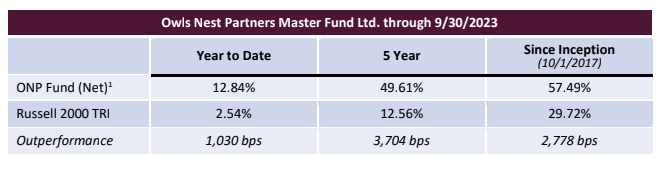
Performance:
Holdings as of 9/30/2023:
We ended the third quarter of 2023 with the following holdings (in order of position size, largest to smallest):
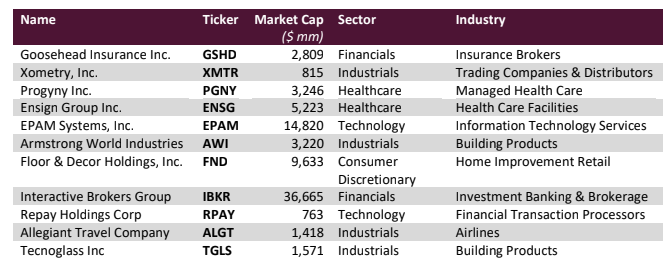
Median Total Debt/Market Cap: 2.2%
Median Market Cap: $3,223 million
Active Share vs. Russell 2000: 99.5%
1Past performance is not indicative of future results. Performance presented from inception through September 2020 is for a representative account of the Owls Nest Partners Concentrated Long Only SMA strategy (the “Strategy”). As of October 2020, performance is for a composite of accounts managed in accordance with the Strategy (the “Composite”). Please see the Disclosures at the end of this document for further information with regards to performance.
Year to Date Attribution:
Year to date out largest gainer has been Goosehead Insurance which rebounded after being dramatically oversold in 2022. You may recall that in the Q4 2022 letter we highlighted that Goosehead was the name we added to most at the end of the year. Goosehead is a good example of our model and why we love owning growing compounders. The world is a tumultuous place, but almost everyone in America has to insure their house and their cars. And in that very stable market, Goosehead is gobbling up share from weaker models including captive insurers like State Farm and smaller sub-scale independent agencies. Goosehead is on track to grow revenues more than 25% in 2023 and dramatically expand its margins. The company’s fundamental performance in 2023 is even more impressive than it appears because they are working through considerable headwinds due to the collapse of existing home sales (which drive insurance shopping) and from the insurance carriers having the worst underwriting results in a generation, which leads to carriers limiting product availability and lower profitability-based contingent commissions. We look forward to 2024 when those headwinds begin to abate and ultimately become tailwinds since Goosehead is the ideal channel for carriers to invest in when they want to grow. While inflation can wreak havoc on insurance carriers who have the obligations to repair and replace damaged property, it is important to remember the long-term impact of inflation on an insurance agency like Goosehead. As a result of the current wave of inflation, the asset values and insurance premiums have gone up very significantly. With its commissions tethered to the amount of premium, an agency earns a greater commission for doing the same amount of work. In time, this 20%+ increase in insurance costs for consumers will simply make the value of Goosehead’s annuity of insurance renewal commission just 20%+ greater than it otherwise would be, making it, perversely perhaps, a long-term beneficiary of inflation.
Xometry has been our largest detractor so far in 2023. Xometry’s stock performance year to date has something to do with disappointing Q4 2022 results that they reported in March but in our opinion is primarily due to its being the holding that is earliest in its life cycle in a market that is definitely “risk off”. We were surprised and disappointed with the Q4 results and had many conversations with management that weren’t exactly lovefests since, to our thinking, part of the issue was an unforced error. In fairness to management, they were responding to an environment in which industry pricing fell with unprecedented speed and magnitude, but that doesn’t get them (or us) off the hook. However, our many calls to customers and suppliers reaffirmed the strength of Xometry’s value proposition. In fact, the incremental news items were that some weaker competitors had shut down, newly added front-end features were very important and well received by customers, and Xometry had
reached a scale at which it could, for the first time, engage fortune 500 companies at the Chief Procurement level. Since the dramatic fall in pricing late last year (15% or so on average), revenue per buyer (a proxy for pricing) has been stable. The impact of stable pricing is that the company’s marketplace revenues (already robust due to 40% active buyer growth) will mathematically get a 15% boost to annual revenue growth rate in Q4 when it no longer has to compare against the high pricing of early 2022. Further, management has done a masterful job growing gross margin, which has expanded from 23.5% three years ago and 28.6% one year ago to 31.7% in the most recent quarter. Importantly, this gross margin expansion is a function of being able to better match
demand for custom manufactured items with the capabilities of the thousands of machine shops on four continents that make up its supplier base, which flows from its having the largest database of custom manufactured orders on the planet against which it can apply the leading AI and machine learning methodologies. While we are unlikely to invest in any AI tools directly because no one can know how that will turn out as countless billions flow into that space to develop the next great application, we will happily own the company that is in a unique position due to scale to put those utilities to work and further pull away from competitors and thrill customers.
Year to Date Portfolio Adjustments:
Given the opportunity we described above in Xometry, we have added very significantly to our position there making it our largest addition year to date. Our next biggest addition year to date is our new position EPAM Systems (EPAM) discussed in detail below. Of late, we have also added meaningfully to Progyny (PGNY) which trades at a significant discount to historical averages and precedent healthcare technology transactions despite growing at a vastly faster rate, having greater market leadership, and possessing enormously superior economics and free cash flow generation. Our largest sale has been to reduce the size of our Interactive Brokers position into strength this year. While the company is still growing at a good clip, the stock has performed well enough that we wanted to redeploy some dollars into the more coiled stocks of Progyny and Xometry. We had a small position in Benefitfocus (BNFT) which was acquired at a premium, freeing up some capital as well. Lastly, we also reduced the size of our position in Floor & Decor earlier in the year when the stock price moved up meaningfully perhaps anticipating an improvement in the current environment earlier than when we think likely. Although Floor & Decor has been a big winner for us since we first bought it and is our second largest gainer this year, it is now our smallest position. That said, our long-term enthusiasm remains. The company’s ability to gain share in this period of depressed existing home sales will only accelerate, especially against the smaller independent and regional chains who still control more than half the industry but who must be hating life right now. Floor & Decor benefitted significantly from the global financial crisis when thousands of independent retailers shut their doors. We expect the same thing to happen during the current contraction in existing home sales, and we look forward to the point when we feel we can add back to our position.
EPAM Systems (EPAM): What Have You Done for Me Lately?
Instinctive human behavior is deeply embedded and very resistant to change, which is why many people still make decisions, even about their investment portfolios, using feelings and intuition which were developed and honed when the primary objective any day was avoiding getting eaten by a saber-tooth tiger. One timeless and sadly pervasive element of the human algorithm is the super self-absorbed, super-short-term memory which is summarized elegantly in The Simpsons, season 14, episode 19 “Old Yeller Belly” which aired May 4, 2003.
Homer: It was probably that stupid cat [referring to an excretion in his lunchbox]
Marge: That cat saved your life.
Homer: What has he done for me lately?
Marge: He woke you up when you stopped breathing last night.
Homer: Yeah, but he ate the last can of tuna.
Lisa: Dad, you ate the last can of tuna.
Homer: Everyone's against me.
The most timeless investment strategies take advantage of outdated flaws in the human psyche as Owls Nest Partners does when we pursue exceptional value in great companies with great long-term prospects that in some way, typically for reasons out of their control, have disappointed diversified, superficially knowledgeable, short-term oriented shareholders who have moved on as quickly as Homer left behind his life-saving cat. Meet EPAM Systems.
EPAM is a leading IT service provider. Specifically, EPAM is generally recognized as the most capable outsourced software engineering firm in the world. At the front end of any IT project there are consulting firms like Bain or McKinsey that can help you define the scope of a project, and on the backend, there is often an outsourced firm (typically located in India) to help you maintain existing mature IT infrastructure. But whether it is a bridge or
software, when you need something built you hire an engineering firm to supplement your internal resources. You may do this for cost-effectiveness but increasingly it is because of the incredible challenges attracting and retaining the best software engineers who inherently are not drawn to large bureaucratic organizations but who need that skillset. EPAM is a global company with more than 50,000 engineers spread across dozens of delivery
centers on six continents. It is headquartered outside of Philadelphia, but historically the largest concentration of engineers was in Eastern and Central Europe.
Any discussion of EPAM must begin with its founder, Ark Dobkin. With essentially no savings, Ark came to this country in 1991 from Belarus. He worked as a software engineer, and then he founded EPAM in 1993 after seeing the great need for high quality, external engineers. For the first decade, EPAM only served software clients like SAP with tactical software development projects as software clients were the only ones who could appreciate
the quality of engineers Ark was able to attract. Once Ark proved EPAM’s engineering capabilities, the next decade was focused on building on behalf of software companies and platform companies like Google. EPAM was winning larger and more strategic work with leading US companies, but its client relationship leaders were all foreigners speaking broken English. To get around this managerial and communication challenge, EPAM built
robust internal technological systems to improve management and service quality. These early investments have been the key enabler for growth allowing the company to scale to where they are today, working on behalf of hundreds of clients across 11 key verticals.
Scale and relationships win in this industry. No business readily entrusts a large project involving sensitive intellectual property to an unknown or unproven vendor. As a result, new customers for an IT service provider typically start with small-scale engagements. However, once a provider has proven itself, clients become more inclined to entrust larger projects, provided the service provider possesses the necessary horizontal (i.e. various technological applications like platform migration and software design) and vertical/domain expertise, along with a track record creating referenceable clients. Simplified, this is the chicken and egg problem. You begin with small projects for new clients in hopes of securing larger opportunities, yet obtaining those larger projects hinges on having previously tackled a similar challenge for another customer—a paradoxical situation given the initial difficulty in obtaining that opportunity.
EPAM has overcome these industry constraints and has built unmatched horizontal and vertical expertise. With a 30-year head start over new competitors, EPAM maintains an average 10-year relationship with its top 20 customers and is twice the size of its closest direct competitor, with more than 100 customers spending over $10M. A concrete example is seen in the case of Thomson Reuters, who was not an EPAM client but which acquired a small company who was using EPAM. Thomson Reuters announced their intention to wind down the EPAM relationship and consolidate that work with their existing provider. They got so far as to cut spend from $30M to $10M before recognizing the highly differentiated, high-quality output from EPAM. Since then, they have extended EPAM's services throughout the organization, resulting in an increase of spend with EPAM to $400M annually. Our conversation with an engineering manager at Thomson uncovered that EPAM now handles
80% of their outsourced engineering work and gets first look at any incremental work thanks to their in-depth industry knowledge, familiarity with Thomson's code base, and comprehensive horizontal capabilities.
Despite their scale, EPAM has intentionally retained the demanding, agile and client focused culture built in the early days working on the most challenging projects for the most sophisticated clients. Ark is fiercely competitive and believes passionately in the mission and the company. Hence the motto: Results. Relentlessly.
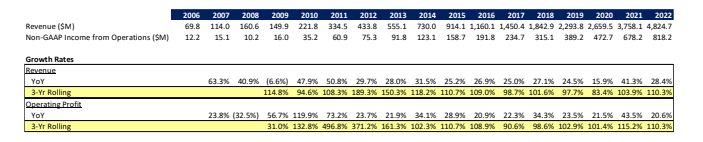
Given Ark’s ambitions, EPAM’s abilities and reputation and the enormous size of the software engineering industry, the company established early-on the goal of doubling in size and profit every three years. This goal was hit during all environments including the Global Financial Crisis and COVID when their great internal systems used to manage, develop, and constantly upskill their engineers adapted easily to work from home. As evident in the table below, EPAM executed amazingly well against this goal from its founding until 2022:
And then Vladimir Putin invaded Ukraine in February 2022. Although the company had been diversifying aggressively out of Ukraine, Belarus, and Russia ever since Putin seized Crimea in 2014, Ukraine remained its largest delivery center. Through heroic efforts, great systems, and employee’s willingness to relocate to stay with EPAM, delivery for clients’ projects was in most cases barely effected by the invasion and war. Clients have told us how they were shocked by how seamlessly things went. That said, all the efforts to ensure customer success came at the expense of growth initiatives. After all, nothing is harder than selling if you cannot be positive about your ability to deliver. While clients retained EPAM, they also understandably diversified to include providers with less exposure to geopolitical hotspots. Additionally, the company has to deal with the fact that some demand was brought forward in the COVID frenzy and IT budgets are now stagnating in the current environment as many companies pull back in this new higher interest rate environment.
EPAM has had to endure a perfect storm, and growth has slowed. The stock is down more than 60% from the pre-invasion high despite growing earnings through that process.
For perspective, despite its meaningful scale, EPAM’s revenues represent less than 1% of its most narrowly defined addressable market of outsourced software development and related services, and most experts expect the industry to grow nearly double digits annually over the next decade. And while EPAM has strategically important scale in an industry that demands it, it can double revenue every three years for decades before approaching the size of some of the industry behemoths. Accenture, for example, effectively hires a new class the size of EPAM every year. There is no shortage of opportunity here, and that is before we toss about the buzzword and subject of the decade, generative AI. While meaningful genAI investments may be years away, there looms a massive wave of investment. While no one can predict the magnitude of spend with certainty, experts we have spoken to have likened genAI to the cloud, the internet, the steam engine, and even electricity.
We liken AI to the opportunity presented by kerosene and petroleum in the mid-1860s. The Civil War accelerated economic development, promoting the growth of factories, mills, and railroads. Kerosene extended the working day as urbanization took over, and petroleum lubricated the processes of new heavy industrial companies. There were abundant use cases, and the demand for these resources skyrocketed. Today, we witness the culmination of decades of investment in the personal computer, followed by the internet, mobile, and the cloud, resulting in an unprecedented amount of data and the necessary tools to process it, thus enabling generative AI. However, akin to the exploratory period of the 1860s, it is virtually impossible to predict the ultimate winner among the various AI tools. Take Pithole Creek, Pennsylvania in January 1865:
“When a tremendous gusher spouted up days later, another madcap chapter in the oil industry commenced, with speculators, drillers, and business agents converging on the spot. Within a few months, the sleepy frontier settlement with four log cabins was transformed into a hectic little metropolis of twelve thousand people. Overnight, fifty hotels sprang up, along with a theater that seated one hundred and was lit by crystal chandeliers...Unfortunately, Pithole’s ebullient heyday was short-lived, and within a few years its wells were exhausted from fire and overproduction.” – Titan, The Life of John D. Rockefeller, Sr.
Rockefeller recognized the surging demand for usable resources, alongside the capital cycles and speculative activities in exploration. He strategically positioned himself as a servicer to the speculators, which ultimately paved the way for the establishment of his unparalleled refining empire. Similarly, EPAM finds itself in a comparable position today. A few things are clear. Before you spend on genAI you must move your data to the cloud then clean and structure it to make it useful. That will require the likes of EPAM. Then there will be a massive wave of spending leaving companies with little choice: either spend on this or fold up your tent and go home. When that wave of investments comes, the necessary talent will be very scarce and very valuable and EPAM with the best reputation of attracting and upskilling the best talent on the newest technologies will shine like never before.
Although it pains a life-long Miami Dolphin and ardent (but non-violent) Philadelphia Eagles fan to admit, the obvious analogy for EPAM today is the situation Tom Brady faced after he went down with a severely torn ACL in the first game of 2008 after winning the MVP in 2007. The media and experts had their doubts, but Brady worked tirelessly to make sure he came back better and stronger than before. Almost embodying the EPAM
motto of “Results. Relentlessly.,” he went on to become the first-ever unanimous MVP in 2010 and to win four more NFL championships. We expect the same out of Ark and the team at EPAM. The war has cost EPAM two years of growth, but already, it has become a much more resilient organization with accelerated progress in diversifying the range of delivery options available to customers and establishing new recruiting channels to
drive growth for the next decade. As was the case the case with Brady, we think the best years are still ahead for EPAM. EPAM’s situation, however, is actually better than Brady’s. Whereas the NFL has a salary cap which constrained the talent that could surround Brady, EPAM is getting back on the field in a big way just as the generative AI wave begins to build. It is almost as if we, EPAM shareholders, are not only getting our G.O.A.T. QB back but are also getting three additional first round draft picks in each of the next five drafts. Go EPAM!
Investment Program:
For the benefit of any first-time readers, the hallmark of the Owls Nest Partners approach is the purchase of industry leading growth companies when a temporary headwind has recoiled the fundamental growth drivers and compressed its multiple. This typically happens as hot money “renters” exit and drive the price down. There is no such thing as a free lunch: we can only receive our requisite value if we accept that our companies will appear “catalyst-less” and uninteresting for some time. We believe we are wildly overcompensated for this modest level of patience, especially since it is in these moments that a company can invest in its own business with the highest returns. There is wonderful optionality associated with a well-run, shareholder friendly, cash- laden company that is able to aggressively put money to work during a temporary headwind.
It is our belief (and experience) that our future outperformance will not be driven by any economic or market forecasting prowess but instead by ten unique investments, each playing out over time. We perceive these investments to have modest downside due to high quality and low expectations, and very significant upside as growth and margin expansion return in spades. We seek reasonable ballast and diversification within the portfolio as a result of our natural conservatism (strengthened by our co-investment alongside clients) and our predisposition to avoid crowded trades and instead invest in temporarily out of favor areas.
Final Thoughts:
More than ever, we thank you for your support and for choosing to have your money working alongside ours.
Gratefully,
Philip, and the Owls Nest Partners team
Disclaimer
In General: This disclaimer applies to this document and the verbal or written comments of any person presenting it. This document has been prepared by Owls Nest Partners IA, LLC as Investment Adviser (the “Adviser”) of Owls Nest Partners Concentrated Long Only SMA (the “Strategy”). By receiving this document you acknowledge that you are an investor in the Strategy, or a prospective investor who is known to the Adviser, and that you meet all regulatory definitions of “Accredited Investor” and “Qualified Client,” in order to be considered a prospective client of the Adviser. The information included herein reflects current views of the Adviser only, is subject to change, and is not intended to be promissory or relied upon. There can be no certainty that events will turn out as the Adviser may have opined herein.
No offer to purchase or sell securities: This document does not constitute an offer to sell (or solicitation of an offer to buy) any security and may not be relied upon in connection with the purchase or sale of any security.
No reliance, no update and use of information: You may not rely on this document as the basis upon which to make an investment decision. To the extent that you rely on this document in connection with any investment decision, you do so at your own risk. This document is being provided in summary fashion and does not purport to be complete. The information in this document is provided you as of the dates indicated and the Adviser does not intend to update information after its distribution, even in the event the information becomes materially inaccurate.
Knowledge and experience: You acknowledge that you are knowledgeable and experienced with respect to the financial, tax and business aspects of this presentation and that you will conduct your own independent financial, business, regulatory, accounting, legal and tax investigations with respect to the accuracy, completeness and suitability of this information, should you choose to use or rely on this document, at your own risk, for any purpose.
No tax, legal or accounting advice: This document is not intended to provide and should not be relied upon for (and you shall not construe it as) accounting, legal, regulatory, financial or tax advice, or investment recommendations. Any statements of U.S. federal tax consequences contained in this document were not intended and cannot be used to avoid penalties under the U.S. Internal Revenue Code or to promote, market or recommend any tax-related matters addressed herein.
Confidential information and distribution: By accepting receipt or reading any portion of this document, you agree that you will treat all information contained herein confidentially. Any reproduction or distribution of this document or any related marketing materials, as a whole or in part, or the disclosure of the contents hereof, without the prior written consent of the Adviser, is prohibited.
Suitability: Any investment program involves a high degree of risk and is suitable only for sophisticated investors who meet certain other suitability standards.
Investment strategies, market conditions and risk disclosures: Notwithstanding the general objectives and goals described in this document, readers should understand that the Adviser is not limited with respect to the types of investment strategies it may employ or the markets or instruments in which it may invest. Over time, markets change and the Adviser will seek to capitalize on attractive opportunities wherever they might be. Depending on conditions and trends in securities markets and the economy generally, the Adviser may pursue other objectives or employ other techniques it considers appropriate and in the best interest of the Fund. No representation or warranty is made as to the efficacy of any particular strategy or actual returns that may be achieved.
Projections: This document may contain certain “forward-looking statements,” which may be identified by the use of such words as “believe,” “expect,” “anticipate,” “should,” “planned,” “estimated,” “potential” and other similar terms. Examples of forward-looking statements include, but are not limited to, estimates with respect to financial condition, results of operations, and success or lack of success of the Strategy’s investment strategy. All are subject to various factors, including, but not limited to general and local economic conditions, changing levels of competition within certain industries and markets, changes in interest rates, changes in legislation or regulation, and other economic, competitive, governmental, regulatory and technological factors affecting a portfolio’s operations that could cause actual results to differ materially from projected results.
PAST PERFORMANCE IS NOT INDICATIVE OF FUTURE RESULTS
Disclosures
- Performance presented from inception through September 2020 is for a representative account of the Owls Nest Partners Concentrated Long Only SMA strategy (the “Strategy”). As of October 2020, performance is for a composite of separately managed accounts managed in accordance with the Strategy (the “Composite”). Performance is presented gross and net of all fees, as of the date listed at the top of this document. The fees applied are the prevailing fees of the Strategy at the time such performance was generated. From inception to the date of this document, the fee structure applied is a 1% annual management fee, and 15% performance fee that is charged only on the outperformance of the Strategy to the Benchmark (as defined below), and only after five years. Performance fees are accrued monthly. The vehicle for the Strategy is a separately managed account. All performance is calculated by the Adviser. Further information regarding the Strategy or the Composite can be provided upon request. The Adviser does not claim compliance with the GIPS reporting standards and the performance presented herein has not been audited or verified by any third-party. The Russell 2000 Total Return Index (the “Benchmark”) is a broad market index that is presented for comparative purposes as the performance benchmark to the Fund. The Benchmark is an unmanaged index consisting of the smallest 2000 stocks in the Russell 3000 Index. The stocks are issued in the United States, and the Benchmark includes the reinvestment of all dividends and income. Because the Benchmark is unmanaged, it assumes no transaction costs, management and performance fees, or other expenses. Unlike the Fund, it contains only domestic companies and is rebalanced monthly. Therefore, while the Benchmark contains publicly traded companies, it does not purport to represent an exact performance comparison to the Strategy. It is not possible to invest directly in an index, such as the Benchmark.
- The Russell 2000 Total Return Index is the performance benchmark for the Strategy (the “Benchmark”). The Benchmark is a domestic equity market index of the 2,000 smallest companies by market capitalization in the Russell 3000 Index. Because the Benchmark is unmanaged, it assumes no transaction costs, management fees or other expenses. The calculation of the benchmark return includes the reinvestment of all dividends. It is not possible to invest directly in an index, such as the Benchmark, and therefore it is presented here for information purposes only.