

- Responsible for new idea generation; portfolio construction; risk management; due diligence
- 25+ years overseeing concentrated small-cap portfolios, on behalf of the most sophisticated allocators in the United States
- Previously: Founder, Endowment Capital Group; Portfolio Manager, Downtown Associates; Analyst, W.H. Newbold’s Son & Company
- University of Pennsylvania, Wharton School, B.S. 1986
- Married to Isabella, 3 sons, 3 daughters, 2 dogs
by Owls Nest Partners on Jul 23, 2025
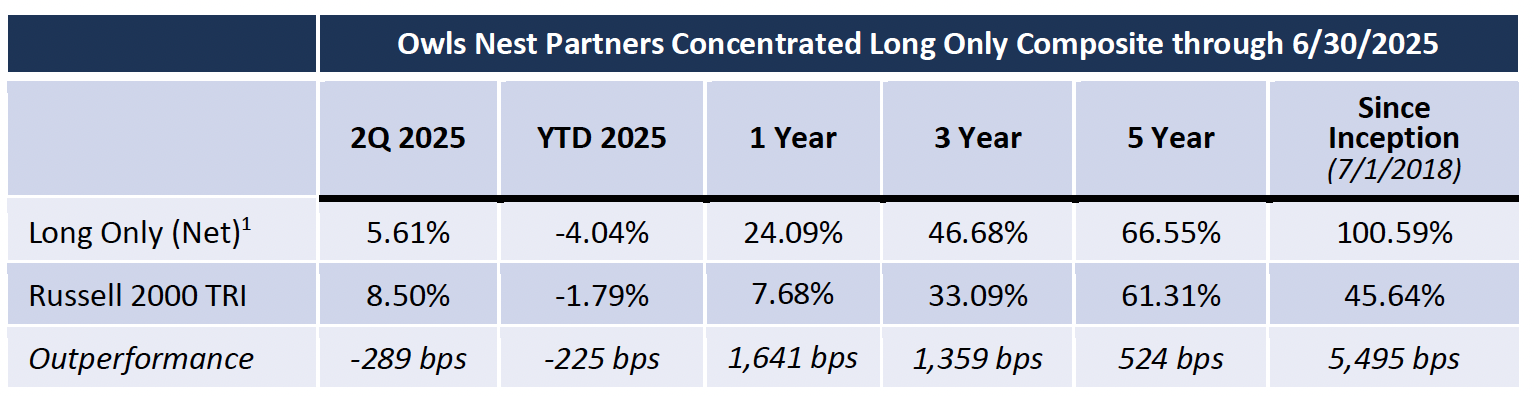
Performance:
Holdings as of 6/30/2025:
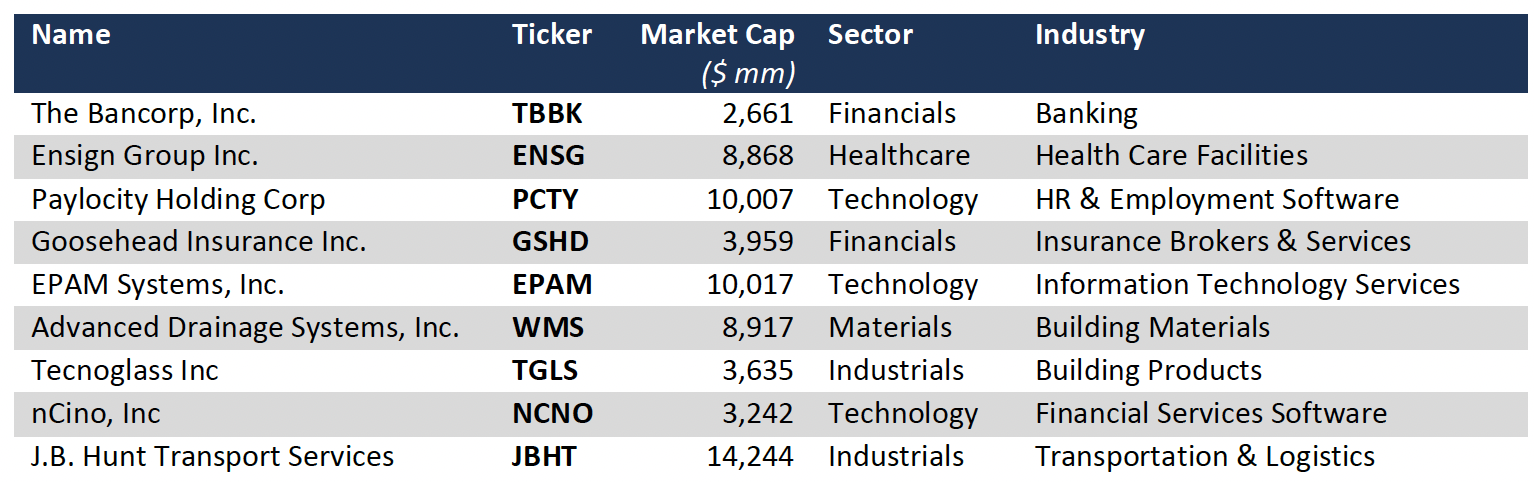
We ended June 30, 2025, with the following holdings (in order of position size, largest to smallest):
Median Net Debt/Market Cap: -1.41%
Median Market Cap: $8,868 million
Median Market Cap at Entry: $2,974 million
Active Share vs. Russell 2000: 99.42%
1Past performance is not indicative of future results. Performance presented from inception through September 2020 is for a representative account of the Owls Nest Partners Concentrated Long Only SMA strategy (the “Strategy”). As of October 2020, performance is for a composite of accounts managed in accordance with the Strategy (the “Composite”). Please see the Disclosures at the end of this document for further information with regards to performance.
Market Commentary and 1H ’25 Attribution
The first six months of 2025 were something of a mirror image of the last six months of 2024. The last half of 2024 saw optimism about a Trump victory and a new administration that would unleash American industrial power. The first half of 2025, however, saw tariffs, trade wars, real wars and a constant barrage of executive order whipsaws, all of which created massive uncertainty which in turn froze decision making and budgets across the economy, especially in areas concerning long-term capital investments and strategy. Moreover, the expected glidepath to lower interest rates was disrupted by expectations of tariff-induced inflation. While the long-term benefits of improved trade arrangements and greater domestic manufacturing capacity and a reduced and rationalized regulatory burden on America are certainly real, the short-term impact has been demand destruction in the real economy and heightened fear in the markets.
The economic slowdown and the uptick in fear in the markets led to a flight to mega-cap safety and suspended for the time being the broadening of investment flows into smaller companies. Accordingly, our first half 2025 stock price performance was uninspiring. But when taken together with the last half of 2024, we show good progress up 24% for the last twelve months. We are especially pleased with the results given the headwinds to small-cap performance, and we are particularly encouraged by the set-up for smaller companies going forward as the market broadens out. The supporting data, in fact, is sufficiently abundant that we have attached the greatest hits as an appendix to the letter rather than spend too much of the letter running through it.
In general, our companies performed well and gained share as expected during the first half of the year, but in some cases they were exposed to the short-term demand destruction described above. Our largest contributor to performance in the first half was long-time holding Ensign Group, which executed extremely well and chugged along with its growth strategy and raised earnings expectations twice. With still less than 3% industry share, Ensign continues to have a long runway of growth, and the outlook is enhanced by a decreased regulatory burden as one potential Biden-era regulation was scrapped. Our largest holding, The Bancorp, also grew as expected and was a positive contributor for the first half. Like Ensign, they will stand to benefit over the next couple years from a more benign regulatory scheme which will enable their fintech partners to innovate more quickly with new debit and credit products. A happy event for the Bancorp in Q2 was the IPO of its major customer, Chime. Having a client better funded to accelerate growth is a great thing, and throughout the process Chime reiterated the importance and strength of the relationship with the Bancorp.
On the other side of the ledger, EPAM was our leading detractor from performance in the first half. In the second half of last year it rallied on hopes that the Ukraine war might end (they still have a large and historically very profitable base of programming talent there) and that IT budgets would open up as companies felt the pressure to prepare their data and IT structure so that they can harness AI tools. The data points we had at the beginning of the year related to spend were very positive. What happened, however, was that the war continued unabated and IT budgets were constrained by new fears around capital spending in an age of constant uncertainty. We can’t hide our vexation related to this pushout of IT budgets, specifically big new business transformation projects that need the help of EPAM. What we do know, however, is that every day pent up demand is being created, the eventual pressure to keep up with competitors using AI will grow even greater, and the talent to leverage these tools will be very scarce. We continue to hear great things about the quality of EPAM’s work and still believe them to be gaining share. In the interim, they continue to buy back stock meaningfully. Intermodal transport giant J.B. Hunt was the other significant detractor, and again uncertainty around tariffs was the driver. There are positive things on the near-term horizon, but the expected rate increases as the freight recession ends and capacity exits are deferred for now by a weak import market. Like EPAM, Hunt is using its fortress balance
sheet to buy back stock as it has opportunistically done with great success at a few other points in the past. Encouragingly, EPAM was able to raise guidance after the first quarter, and Hunt, who issues no guidance, was able to beat expectations in both January and April.
1H 2025 Portfolio Adjustments
The biggest moves in the quarter reflect not only optimizing the portfolio around the risk/reward of individual names, but our very intentional effort to keep raising the bar in terms of persistent quality of the portfolio. It is our strong belief (and we are invested alongside you), that we want exposure to smaller companies as the market breaks away from this unprecedentedly long period of narrowness and large/mega cap investor focus, but that at the same time we want to stay high on the quality spectrum. The largest flow was the addition of a new position, software company nCino, and completing the exit of manufacturing marketplace, Xometry. Both moves are described in more detail below, but we have a classic, coiled ONP “triple win” opportunity in nCino, whereas Xometry stock has performed especially well over the last twelve months due to better execution but also anticipated benefits from manufacturing on-shoring which may or may not play out in the time frame investors expect. Further, we are replacing a volatile marketplace model which has limited visibility with a high visibility recurring revenue software-as-a-service model.
In the face of changing end markets, we reluctantly lightened up on JB Hunt and, to a lesser degree, EPAM. When the facts and outlook change, you need to be flexible. And one of the advantages of our capacity constraint is that we can adjust position sizes much easier than our scaled competitors. As you know, we monitor these end markets very closely, and we expect that we will add back to Hunt and EPAM when the incremental data points inflect positively. They are great long-term investments, and we are happy to own them. We don’t want to be too cute, since great companies have a wonderful ability to surprise you on the upside, and you want to be there. But we don’t want to use dry powder to overweight without confidence of end market strengthening. Although Tecnoglass has sailed through without any tariff impact and without any demand destruction related to higher prices and uncertainty in the residential and commercial construction businesses, we chose to be proactive and trim that position some as well.
The reason for the Xometry sale and the trims mentioned was to fund the purchase of nCino and to add to a few positions. Beyond nCino, the largest increase was in the size of the Bancorp position helping give us lots of value as well as quality. The valuation of The Bancorp is completely unsustainably cheap, and the significant buyback by a management team that is very closely aligned to its shareholders gives extra reason to be confident. We also added modestly to our Advanced Drainage (WMS) position when the stock price shrank on “Liberation Day” fears. One counter-intuitive reason we added to our WMS position is their suspension of their buyback program. We view that a possible meaningful positive because the only real justification is that they are looking at doing an acquisition. They have a great track record of acquisitions that are both strategically and financially accretive, and we know one meaningful asset that has come to market which would fit brilliantly into the WMS offering. While we would not base a position on this sort of speculation only, we would be very happy and not entirely surprised to see something happen in the next three months.
Sale of Xometry (XMTR): Clear Leadership, Cloudy Horizon
In many ways our original thesis on Xometry has been validated over the last few years and remains valid. They have done an admiral job on marketplace revenues, growing 48%, 30% and 23% in 2022, 2023 and 2024 despite a significant manufacturing slowdown that caused key competitors to shrink, consolidate or even restructure/disappear. Moreover, the progress on marketplace gross margin has greatly exceeded what we thought possible, expanding from 26% to 34% from 2021 to 2024. With the help of timely adding and trimming, Xometry has been a positive contributor for us, and it still controls a small fraction of what it views as its addressable market.
Why then would we sell Xometry? The challenge for us is that the drivers of the next leg of growth are coming along more slowly than we need them to. Xometry has done a great job attracting engineers, whether acting as an individual or as part of a large design group at a Fortune 500 company, for prototype manufacturing. The next phase of growth requires large enterprise buy-in as a short-list supplier for prototyping and then the ability to compete for and win small and mid-size production runs. Many customers have told us this is logical or even inevitable. We agree, but we think getting large corporations and long-tenured engineers to change their way of business is proving to be more difficult than the company or we expected and certainly more difficult than was implied in the expectations associated with the stock price after the last 2024 run-up.
Additionally, we have been intentionally reducing exposure to companies whose business model has a relatively high degree of volatility. As exciting as the potential upside in Xometry is – being the Amazon of custom manufacturing – we need to concern ourselves with the full range of possible outcomes, and our budget for companies with even remotely meaningful uncertainty as to ultimate outcome has effectively shrunk to zero. With our significant advantages buying great quality compounders during headwinds that shake out short-termers and holding them until a tailwind attracts all the incremental buyers, we do not need to risk capital on speculation where there is any real risk of fundamental downside in the long-term.
The opportunity to invest – both our capital and our time – in nCino made the decision to sell Xometry easier, but we would have sold Xometry even if we did not have the i’s dotted and the t’s crossed on nCino since we want all of our resources focused on the highest quality and the best value we can find for every dollar.
nCino (NCNO): Built Inside the Bank. Mispriced Outside It.
nCino is a vertical SaaS juggernaut transforming how banks lend, onboard, and serve customers. What makes this special is that it wasn’t dreamed up by consultants or VCs. The company was born inside a live bank, built by actual bankers to fix the real pain they were feeling. That origin-story matters because banks are conservative, compliance-heavy environments where technology has to work the first time, every time. Over time, what began as a better mousetrap for one bank’s commercial lending has evolved into a full platform used by more than 2,800 financial institutions.
At its core, this is a replacement cycle story—a modern, cloud-native solution steadily taking share from brittle legacy systems, with a clear ROI: faster credit decisioning, better compliance, improved customer experience, and lower costs. Banks like Wells Fargo have called adopting nCino an “easy decision”—the gold standard platform, replacing a lattice of homegrown, siloed systems that couldn’t talk to each other, and validated by
blue chip clients like Bank of America and TD Bank. That kind of endorsement carries weight in a risk-averse industry.
Inertia works both ways. Banks are notoriously slow to change, but once they find a partner that works, they stick with it. Getting in is hard, but the annuity, once earned, is long lasting and continually growing. Once deployed, nCino becomes the “system of record” where credit officers write memos, where risk teams model exposure, and frontline staff onboard and underwrite customers. Implementation is not trivial, but that’s the point—it becomes embedded. And from there, the expansion opportunities are wide open. Even in commercial—the area where nCino has been longest and strongest—penetration is still under 30% when you consider the full cross-sell potential. Consumer and small business lending, where the products are newer, are both under 15%.
We seldom look seriously at IPOs, but we worked hard on nCino during its 2020 IPO because of the strong customer commentary we heard. Eventually we couldn’t get comfortable with valuation and the embedded growth assumptions which required persistently strong end markets and perfect execution including flawless acquisition integration. For a time, the bulls won, and the stock went on a tear. Then reality and the nature of cycles and market pressures set in. The stock, which nearly broke through $100 in the early excitement, now trades quietly between $25 and $30, well below the initial IPO price. In that time, revenues have more than tripled, the product suite has been built out, the go-to market motion has been greatly tightened up, and the company has grown into its ambition. The valuation, on the other hand, has gone the other way. That gap between progress and perception is exactly why this is such a compelling entry point. But that disconnect exists for a reason—and to understand the opportunity, you have to understand what did not go as planned.
The unanticipated spike higher in interest rates created a run on deposits for banks as their clients moved money to higher yielding money market funds. Deposit withdrawals in conjunction with bond market declines created a regional banking crisis which spurred bank failures and great fear until the Fed acted to control any contagion. But nCino’s customers reacted by shifting away from lending automation and toward deposit retention and balance sheet defense. nCino, long the leader in commercial lending, saw deals stall and budgets tighten. The company didn’t help itself either—the consumer lending product was slow to launch, the 2021 mortgage acquisition was poorly timed, and go-to market execution in credit unions and international markets fell short. In our view, these are fixable challenges and shortcomings of high growth companies trying to justify a high multiple, and we weren’t surprised to see the end result. We often point out that even the strongest industry leaders encounter temporary headwinds, which creates the best investment opportunities with the most positively asymmetrically skewed ratios of achievable reward for risk taken. nCino became a textbook example. At the same time, there is a playbook for recovering from those woes which can be very rewarding when the core product is strong and loved in the marketplace as is the case with nCino. Reemergence in the stock market typically begins with a management change to a focus on execution rather than pure vision and by resetting expectations, and that is exactly what nCino has done in the last 12 months.
And now execution and momentum are building again. Technology budgets are loosening, and banks are restarting projects that had been paused during the crisis. FirstCitizens, a $200 billion institution, will go live with nCino’s consumer offering this year. Two other banks with tens of billions in assets have signed on recently, and the commercial flywheel that once powered early growth now appears to be spinning up in consumer. Mortgage, while still underpenetrated, is gaining share and growing—even in a tough rate environment. Onboarding, account opening, and analytics are also showing early traction.
The progress isn’t limited to the install base. Refined go-to market efforts in credit unions and international markets are putting the company in a better position to win new customers. The company is also flexing its pricing power through a new platform-based model that adds a few points of growth and better aligns revenue with customer growth.
And then there’s AI. With its generative AI powered solution “BankingAdvisor”, nCino is beginning to roll out embedded intelligence across the platform—not just as an add-on, but as a core capability that amplifies productivity, sharpens risk management, and unlocks new levels of insight. With proprietary data, deep workflow integration, and years of trust with customers, nCino is well positioned than most to turn AI into durable advantage. This is not some vaporware that exists only in press releases. This is real and in production. At the most recent users conference, we saw first-hand the excitement of customers and prospects related to the AI driven capabilities. And this greatly expands the competitive differentiation. In house solutions, cannot have the benefit of a broad industry wide data pool to draw on, and old legacy players fighting tech debt aren’t credible. As a result, these new capabilities have the ability to accelerate deals which had been stuck due to inertia.
What we admire most is the clarity of focus. This isn’t a horizontal SaaS business chasing every market. It’s a single vertical platform, purpose built for one of the most complex and largest sectors in the economy. That focus has made the business more efficient over time. With the heavy lift of product development largely behind it, nCino now has a clear path to reaccelerating growth and margin expansion—driven by scaled operations, improved sales efficiency, smarter implementation models, and leverage across development and services.
Put it all together and the setup is rare: a category leader with embedded workflows, expanding use cases, and long-term contracts—emerging from a reset with stronger execution, cleaner economics, and real tailwinds at its back, all while trading at a deep discount to vertical SaaS peers and precedent transactions. We’ve followed this company for a long time, and we are grateful to have dodged the period of lofty/unrealistic expectations and losses on the stock. Now we have the inverse, and we believe our experience and patience will be greatly rewarded.
Changing Custodians from Bank of America to Pershing
Since inception, we have custodied our funds at Bank of America. Our logic was and remains that we were unwilling to compromise on financial strength when selecting a custodian and only wanted one that was “too big to fail”. Since our launch, BofA has become less committed to smaller funds and more difficult to work with. Our introducing prime broker, Jones Trading, has opened up a relationship with Pershing, a subsidiary of very conservative and too large to fail Bank of New York. We appreciated getting to know Pershing, who was also enthusiastic about earning our business. We moved both funds to Pershing at the end of June, and we will move an SMA over in July.
The move to Pershing not only makes things operationally easier for us, but it will also lower our overall custody costs. Pershing also has some added benefits including improved money market sweep capabilities and better terms related to lending of securities. At the end of the day, the move went off without a hitch and will be seamless to clients. We just wanted to alert any avid readers of our year end financials to not be surprised by the change of custodians. Also, I wanted to highlight the considerable work our operations team has done this
year including upgrading our Trade Order Management System (from Liquidity Book to Eze Eclipse), upgrading our internal IT managed service provider, and upgrading our internal HR platform.
Investment Program
For the benefit of any first-time readers, the hallmark of the Owls Nest Partners approach is the purchase of smaller, industry leading companies when a temporary headwind has recoiled the fundamental growth drivers and compressed their multiple. This typically happens as hot money “renters” exit and drive the price down. There is no such thing as a free lunch: we can only receive our requisite value if we accept that our companies will appear “catalyst-less” and uninteresting for some time. We believe we are handsomely rewarded for this modest level of patience, especially since it is in these moments that a company can invest in its own business with the highest returns. There is wonderful optionality associated with a well-run, shareholder friendly, cash-laden company that is able to aggressively put money to work during a temporary headwind.
It is our belief (and experience) that our future outperformance will not be driven by any economic or market forecasting prowess, but instead by ten unique investments, each playing out over time. We perceive these investments to have modest downside due to high quality and low expectations, and very significant upside as revenue growth and margin expansion return in spades and as increased investor confidence justifies a higher multiple of earnings for the company’s stock. We seek reasonable ballast and diversification within the portfolio as a result of our natural conservatism, strengthened by our co-investment alongside clients.
Final Thoughts
More than ever, we thank you for your support and for choosing to have your money working alongside ours.
Gratefully,
Philip, and the Owls Nest Partners team
Disclaimer
In General: This disclaimer applies to this document and the verbal or written comments of any person presenting it. This document has been prepared by Owls Nest Partners IA, LLC as Investment Adviser (the “Adviser”) of Owls Nest Partners Concentrated Long Only SMA (the “Strategy”). By receiving this document you acknowledge that you are an investor in the Strategy, or a prospective investor who is known to the Adviser, and that you meet all regulatory definitions of “Accredited Investor” and “Qualified Client,” in order to be considered a prospective client of the Adviser. The information included herein reflects current views of the Adviser only, is subject to change, and is not intended to be promissory or relied upon. There can be no certainty that events will turn out as the Adviser may have opined herein.
No offer to purchase or sell securities: This document does not constitute an offer to sell (or solicitation of an offer to buy) any security and may not be relied upon in connection with the purchase or sale of any security.
No reliance, no update and use of information: You may not rely on this document as the basis upon which to make an investment decision. To the extent that you rely on this document in connection with any investment decision, you do so at your own risk. This document is being provided in summary fashion and does not purport to be complete. The information in this document is provided you as of the dates indicated and the Adviser does not intend to update information after its distribution, even in the event the information becomes materially inaccurate.
Knowledge and experience: You acknowledge that you are knowledgeable and experienced with respect to the financial, tax and business aspects of this presentation and that you will conduct your own independent financial, business, regulatory, accounting, legal and tax investigations with respect to the accuracy, completeness and suitability of this information, should you choose to use or rely on this document, at your own risk, for any purpose.
No tax, legal or accounting advice: This document is not intended to provide and should not be relied upon for (and you shall not construe it as) accounting, legal, regulatory, financial or tax advice, or investment recommendations. Any statements of U.S. federal tax consequences contained in this document were not intended and cannot be used to avoid penalties under the U.S. Internal Revenue Code or to promote, market or recommend any tax-related matters addressed herein.
Confidential information and distribution: By accepting receipt or reading any portion of this document, you agree that you will treat all information contained herein confidentially. Any reproduction or distribution of this document or any related marketing materials, as a whole or in part, or the disclosure of the contents hereof, without the prior written consent of the Adviser, is prohibited.
Suitability: Any investment program involves a high degree of risk and is suitable only for sophisticated investors who meet certain other suitability standards.
Investment strategies, market conditions and risk disclosures: Notwithstanding the general objectives and goals described in this document, readers should understand that the Adviser is not limited with respect to the types of investment strategies it may employ or the markets or instruments in which it may invest. Over time, markets change and the Adviser will seek to capitalize on attractive opportunities wherever they might be. Depending on conditions and trends in securities markets and the economy generally, the Adviser may pursue other objectives or employ other techniques it considers appropriate and in the best interest of the Fund. No representation or warranty is made as to the efficacy of any particular strategy or actual returns that may be achieved.
Projections: This document may contain certain “forward-looking statements,” which may be identified by the use of such words as “believe,” “expect,” “anticipate,” “should,” “planned,” “estimated,” “potential” and other similar terms. Examples of forward-looking statements include, but are not limited to, estimates with respect to financial condition, results of operations, and success or lack of success of the Strategy’s investment strategy. All are subject to various factors, including, but not limited to general and local economic conditions, changing levels of competition within certain industries and markets, changes in interest rates, changes in legislation or regulation, and other economic, competitive, governmental, regulatory and technological factors affecting a portfolio’s operations that could cause actual results to differ materially from projected results.
PAST PERFORMANCE IS NOT INDICATIVE OF FUTURE RESULTS
Disclosures
- Performance presented from inception through September 2020 is for a representative account of the Owls Nest Partners Concentrated Long Only SMA strategy (the “Strategy”). As of October 2020, performance is for a composite of separately managed accounts managed in accordance with the Strategy (the “Composite”). Performance is presented gross and net of all fees, as of the date listed at the top of this document. The fees applied are the prevailing fees of the Strategy at the time such performance was generated. From inception to the date of this document, the fee structure applied is a 1% annual management fee, and 15% performance fee that is charged only on the outperformance of the Strategy to the Benchmark (as defined below), and only after five years. Performance fees are accrued monthly. The vehicle for the Strategy is a separately managed account. All performance is calculated by the Adviser. Further information regarding the Strategy or the Composite can be provided upon request. The Adviser does not claim compliance with the GIPS reporting standards and the performance presented herein has not been audited or verified by any third-party. The Russell 2000 Total Return Index (the “Benchmark”) is a broad market index that is presented for comparative purposes as the performance benchmark to the Fund. The Benchmark is an unmanaged index consisting of the smallest 2000 stocks in the Russell 3000 Index. The stocks are issued in the United States, and the Benchmark includes the reinvestment of all dividends and income. Because the Benchmark is unmanaged, it assumes no transaction costs, management and performance fees, or other expenses. Unlike the Fund, it contains only domestic companies and is rebalanced monthly. Therefore, while the Benchmark contains publicly traded companies, it does not purport to represent an exact performance comparison to the Strategy. It is not possible to invest directly in an index, such as the Benchmark.
- The Russell 2000 Total Return Index is the performance benchmark for the Strategy (the “Benchmark”). The Benchmark is a domestic equity market index of the 2,000 smallest companies by market capitalization in the Russell 3000 Index. Because the Benchmark is unmanaged, it assumes no transaction costs, management fees or other expenses. The calculation of the benchmark return includes the reinvestment of all dividends. It is not possible to invest directly in an index, such as the Benchmark, and therefore it is presented here for information purposes only.