

- Responsible for new idea generation; portfolio construction; risk management; due diligence
- 25+ years overseeing concentrated small-cap portfolios, on behalf of the most sophisticated allocators in the United States
- Previously: Founder, Endowment Capital Group; Portfolio Manager, Downtown Associates; Analyst, W.H. Newbold’s Son & Company
- University of Pennsylvania, Wharton School, B.S. 1986
- Married to Isabella, 3 sons, 3 daughters, 2 dogs
by Owls Nest Partners on May 18, 2026
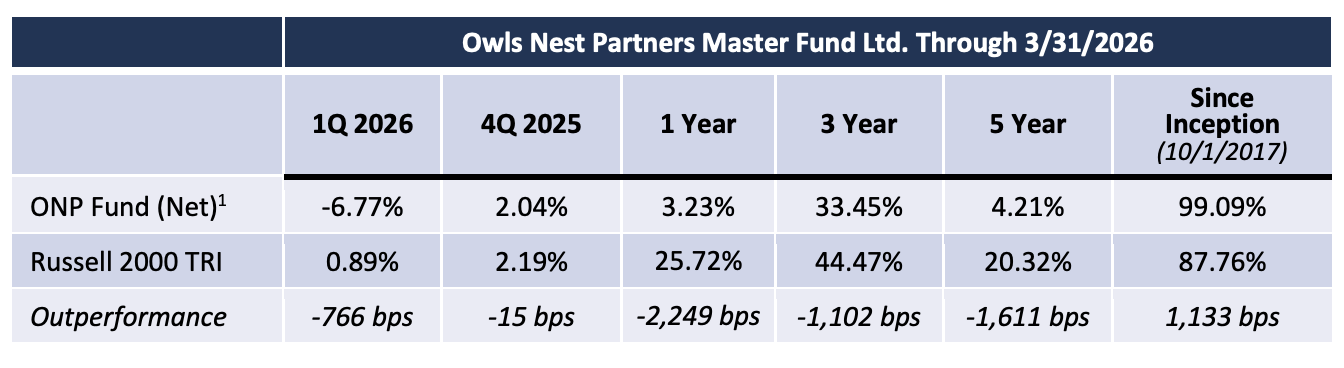
Performance:
Holdings as of 3/31/2026
We ended March 31, 2026 with the following holdings (in order of position size, largest to smallest):
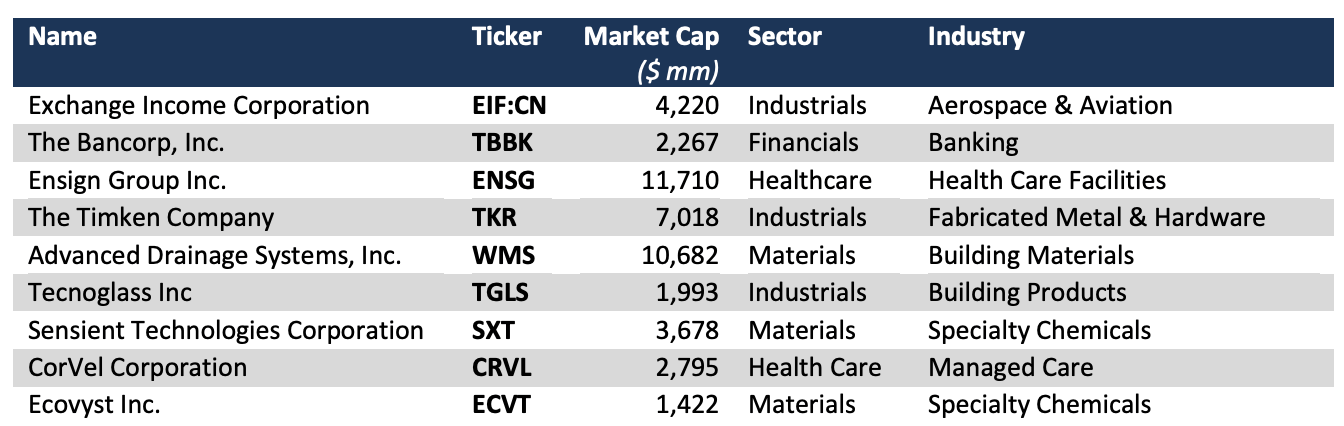
Median Net Debt/Market Cap: 14%
Median Market Cap: $3,678 million
Median Market Cap at Entry: $2,316 million
Active Share vs. Russell 2000: 99.59%
1Past performance is not indicative of future results. Performance is presented for the Owls Nest Partners Master Fund Ltd., net of management fees and anticipated performance fees, and is calculated at the master fund level incorporating all fund investors. Not all investors pay the same fees, therefore individual returns are different and may be higher or lower than the returns shown above.
Playing To Your Strengths
The setup for your investment in Owls Nest Partners has never looked better. In this letter, we will explain why we - despite, or perhaps because of our recent underperformance - are so confident in that statement. After that, we will walk you through what you own now and why you, as an owner of these companies, should be excited for the near and intermediate term, as well as the long term. But first, a mea culpa about recent performance along with a discussion of the steps we have taken to make sure that future performance is consistent with your portfolio manager’s long, historical track record of great performance and outperformance.
The frustrating performance of late is the result of mistakes we made after a 2023 in which we were up more than 38% net and which extended our cumulative performance to nearly triple the index (up 97% net compared to 33% for the Russell 2000 total return). This was a time when we should have been feverishly looking for the next generation of names to drive performance. But, in hindsight, we sat too contentedly expecting the names we owned to keep powering on despite some of the levers of performance being spent at least for the near term. Your portfolio manager has to take the blame for this complacency. The opportunities were there and right in our wheelhouse. It's great to be a patient, long-term investor, but it's equally important to get as much bang for every buck invested, inside the constraint of your volatility budget.
We have not and will not change anything in our approach to investing. Buying high quality companies that are expanding their moat against weak competitors that are on the verge of reaccelerating from a downturn that left fundamentals coiled and the stock cheap is a proven strategy and is real investing as opposed to speculation. But we needed to be more diligent about the strength and durability of the reacceleration, and we needed to concentrate our effort on the less followed names where our edge is greatest. We have moved with urgency. We are back on offense, and we are energized by the opportunities.
First - In football, if you have a great quarterback and wide receivers that no one can cover, you don't make a game plan based on running the ball up the middle. You maximize the value of the mismatch. At Owls Nest, our greatest advantage lies in our unique structure in alignment with long-term investors. Capacity constraint, concentration, and the ability to think in terms of quarters and years allow us to go where others cannot and do not. Whereas others engaged in our core area of the market rely on readily available, mostly superficial and almost entirely backward facing data, we can build the most complete fundamental company and industry mosaic over any investment horizon centered on the true drivers of long-term performance. Our recent investments are squarely in the middle of our strike zone.
Second – We have added energy and resources to our new idea screening process. Larson Rice joined us from Truist Securities in New York earlier this year, where he had been a sell-side consumer junior analyst fortunately used to working horrific hours. We have put him in charge of rebuilding our screening function. We have built fundamentally based screens that mirror our thought process on what leads up to and reflects the next great triple win Owls Nest style opportunity. Our back testing these screens revealed results completely consistent with what we expected, showing the great universe where we can put our edge to extremely profitable work.
We have already put these lessons to work. The changes are in place. Our newest seasoned investments, Ecovyst (ECVT), Exchange Income (EIF), and Sensient (SXT) have performed admirably. Some are discussed in detail below, but others are not because we are still building positions in them or, in the case of Ecovyst, they have already worked well, and we are (without complacency) recycling the dollars into new ideas with more upside consistent with the pace of new idea generation we discussed above.
So why has the set up for your investment in Owls Nest never looked better? Some of it is internal. We've never been hungrier, and we've never had a chip of this size on our shoulder. Secondly, we have never been as tightly focused on the universe, where our edge is greatest. Third, and this is a classic story as old as time which has created extremely profitable harvests in the past, when money and attention floods into a narrow area, it leaves other pockets very cheap and underfollowed. And those are pools in which we play. Our research process’s unfair advantage now has an unfair advantage in terms of the universe to which it applies itself. We've never been more excited about the outlook for Owls Nest, and we’ve never been as bullish on our ability to grow the $60M that the partners have invested in the fund.
Thank you for your support. Below are the theses and updates on seven of the 11 names you currently own. Together they make up more than 75% of the portfolio. You should be very happy to own these companies, which combine quality, value, and growth, and which have a long runway of performance ahead.
What You Own – Portfolio Overview (Largest to Smallest Position Size)
Exchange Income (EIF-CN)
What They Do
Exchange Income Corp. acquires founder-led, mission-critical aviation and industrial service businesses and uses its capital, operating discipline, and M&A expertise to strengthen existing moats, accelerate growth, and compound capital over time.
High-Level Thesis
Exchange Income Corp. combines one of the most impressive capital allocation records of the past two decades with growing strategic relevance. Its portfolio of impossible to replicate assets makes it a beneficiary of several compelling long-term themes, including Canada’s push to defend and develop the North, rising global demand for surveillance and sovereign monitoring capabilities, and the buildout of the grid and critical mineral infrastructure. As those themes translate into new contracts and higher activity, EIF looks poised for another leg of durable growth.
Why Own This Business?
Compounding shareholder capital at more than 21% annually for over 20 years is an extremely challenging task. That is why only 27 of roughly 8,000 public companies in North America in 2005 have managed to do that. Only 6 of those 27 did so primarily through earnings growth rather than multiple expansion (less than 2 turns of multiple expansion), which is the higher quality route since multiple expansion is out of control of the company and since ideally as a shareholder you’d like to have multiple expansion as a potential future lever, not used and spent. More impressive still, Exchange Income stands apart for the consistency of that performance: it is the only company in that group that did not experience a single calendar year with a drawdown worse than 15%. And for those that are worried about cyclicality, it compounded at 14% through the Global Financial Crisis from 2007 to 2009.
How does one do this? Through disciplined capital allocation and abundant opportunities to reinvest capital, both organically and inorganically. Exchange Income has built a reputation as the kind of long-term owner that founder-led businesses want to sell to, more akin to Berkshire Hathaway than private equity, allowing owners to de-risk personally while still seeing their companies continue to grow without the pressure of a future sale. That credibility is reinforced by the fact that Exchange Income has never sold a business. Management evaluates both acquisitions and internal projects against a strict 15% cash-on-cash hurdle, keeping growth firmly anchored to returns. This has enabled the company to assemble a collection of niche businesses with durable demand, dominant competitive positions, and significant room to grow. Its essential air operations serve remote Northern communities where roads cannot be built, giving the company monopoly-like positions across roughly two-thirds of Northern Canada. Its Intelligence, Surveillance & Reconnaissance (ISR) business is becoming increasingly strategic in a world that needs more maritime surveillance, border protection, and sovereign monitoring, while its industrial subsidiaries serve specialized end markets where scale, relationships, and operating know-how create enduring advantages.
Why Own This Business Now?
-
The July 2025 Canadian North acquisition (paid ~2.5x EBITDA post contract renegotiations) further cements Exchange Income’s dominance in the North and materially increases its exposure to Arctic sovereignty, defense, and northern development, all of which are becoming more important themes in Canada. With the heavy lifting of integration and reinvestment largely complete, Canadian North is now positioned to contribute much more meaningfully to earnings and cash flow.
-
The ISR pipeline is the most attractive it has ever been, with active opportunities across Australia, Canada, and Greenland, while rising utilization on existing programs is driving high-margin growth with minimal incremental capital.
-
Several industrial businesses are inflecting at once, with growing exposure to transmission and distribution buildout, critical mineral development, and other infrastructure investments needed to support rising data center demand.
-
Exchange Income’s newly achieved investment-grade rating lowers its cost of capital, reduces financing friction, and accelerates the compounding flywheel.
-
A large base of incremental buyers still lies ahead: Exchange Income has just one U.S. analyst, has almost no institutional ownership, and is only beginning to benefit from structural demand tied to index inclusion. At the same time, “Defending the North” gives the company a clear and durable theme that should broaden the shareholder base over time.
The Bancorp (TBBK)
What They Do
The Bancorp is the behind-the-scenes banking infrastructure provider powering many of the largest fintechs in the U.S. Through its scaled sponsor bank platform, it enables partners to offer banking, payments, lending, and other financial products to millions of end customers.
High-Level Thesis
The Bancorp has become the toll road behind many of the largest fintechs in the U.S. by establishing itself as the gold standard in sponsor banking infrastructure. As fintechs continue taking share from traditional banks with lower-cost, more modern offerings, The Bancorp benefits by clipping a fee from the growing volume of transactions flowing through its platform. With unmatched scale, deep compliance expertise, decades of experience working with regulators, and relationships with category-leading partners such as Chime, Cash App, and Venmo, The Bancorp sits at a critical chokepoint in one of the most attractive parts of the financial services stack.
Why Own This Business?
The Bancorp is not just renting out its bank charter. Sponsor banking is a fixed-cost, compliance-intensive business where scale, trust, and regulatory credibility matter, and those advantages have become harder to replicate as the industry has matured. More partners create more data, better risk models, lower unit costs, and deeper operating know-how, which is why the strongest platform tends to get stronger over time. The Bancorp is already the largest issuer of debit cards in the U.S. outside the money-center banks and the low-cost provider in sponsor banking, allowing it to deliver these services more cheaply, more efficiently, and with stronger risk controls than partners could build on their own.
What makes the company especially compelling is that this scale is reinforced by a regulatory and structural moat that is extremely difficult to replicate. Over more than a decade, and with more than $100 million invested in compliance, risk management, and operating infrastructure, The Bancorp has built the strongest sponsor banking platform in the industry. The real barrier is not obtaining a bank charter, but building the systems, regulatory credibility, and operational know-how needed to operate safely and at scale. There is already a graveyard of banks that entered sponsor banking without that investment or experience, only to be hit with consent orders that halted growth and pushed them out of the market.
The Durbin Amendment, attached to the Dodd Frank Act of 2010, adds another layer of protection. It caps the debit card interchange fees banks above $10 billion in assets can charge, which reduces the economics larger banks can offer fintech partners. By staying below that threshold, The Bancorp preserves materially better debit economics for itself and its partners, creating a structural advantage that larger banks cannot match. That same constraint also creates an unusually attractive capital allocation model. Because balance sheet growth is intentionally limited, the company can direct all earnings to repurchases, turning a high-return, fee-driven business into a powerful per-share compounding engine.
Why Own This Business Now?
-
The largest fintech by purchasing volume, Cash App, began onboarding in 1H26 and should become an important driver of fee growth as card migration builds through the year. Management has also indicated that several other recognizable partners are expected to come online over the course of 2026.
-
Credit sponsorship is emerging as an important growth driver. Here, The Bancorp provides the regulated banking balance sheet and infrastructure behind fintech lending programs, earning fee income on loans without taking traditional bank-like credit risk. These programs drive higher fee revenue while shifting the business toward a cleaner, lower-risk, and increasingly fee-driven model.
-
“Embedded finance” dramatically broadens The Bancorp’s opportunity set. The company is moving beyond traditional fintech sponsorship into bank-led solutions for digital platforms. That expansion opens the door to non-traditional fintech verticals, including gig economy platforms like Uber or even YouTube, where use cases such as driver or content creator early wage payouts illustrate how The Bancorp can deliver a much broader and more valuable service stack than its historic offering to neobanks.
-
The valuation does not reflect the quality of the business. Despite a Visa/Mastercard-like economic profile with a 30% ROE, The Bancorp still trades like a regional bank at ~7x 2027 earnings. Until that gap closes, aggressive buybacks at today’s valuation remain highly accretive and give shareholders another clear path to value creation.
Advanced Drainage Systems (WMS)
What They Do
Advanced Drainage Systems is the leader in stormwater and wastewater management, providing the pipes, chambers, septic systems, and water quality products needed to capture, convey, store, and treat water across residential, commercial, agricultural, and infrastructure end markets.
High-Level Thesis
Advanced Drainage Systems sits at the center of a long-term material conversion in water infrastructure. As plastic products continue taking share from concrete because they are lower cost and require less labor and equipment to install, WMS is positioned to benefit as the clear scale leader in the category. At the same time, management has been reshaping the portfolio toward faster-growing, higher-margin engineered products, turning what is often wrongly viewed as a simple pipe business into a much higher-quality, engineer-specified water management platform.
Why Own This Business?
Advanced Drainage operates in a category where demand is supported by regulation, ongoing land development, and the need to upgrade aging water infrastructure. More volatile and intense rainfall, evolving stormwater standards and permitting expectations, and decades of deferred investment are also forcing overdue spending on stormwater systems. Stormwater and wastewater systems are not optional, but required by code for new construction and redevelopment. That creates a durable demand base tied to long-lived infrastructure needs rather than discretionary spending. Within that market, WMS is the clear leader in plastic pipe, with roughly 10x the scale of its nearest competitor, strong specification influence among engineers, deep relationships with distributors, and a service model built around local availability and jobsite delivery.
That leadership matters because plastic drainage is a fundamentally better product than reinforced concrete pipe in the vast majority of instances. It is cheaper, faster to install, and requires less labor and equipment, giving customers a clear economic incentive to convert over time. WMS’s scale is reinforced by vertical integration as one of the largest recyclers of plastic in the U.S., helping lower input costs, secure supply, and deepen its cost advantage over smaller competitors. Concrete still holds meaningful share because of legacy municipal codes and long-standing engineering habits, but plastic continues to gain share as those barriers gradually fall and the superior economics of plastic continue to win out. This creates a long and still underappreciated runway for WMS to keep taking share as conversion economics increasingly overwhelm legacy habits and codes.
What makes WMS especially compelling is that it is not simply riding a long conversion tailwind. Since 2017, management has used disciplined capital allocation to reshape the business toward structurally better growth and margins, more than doubling sales and increasing EBITDA roughly fivefold over that period. As the portfolio continues to shift toward higher-engineered and higher-margin solutions, WMS should increasingly be recognized not as a commodity pipe company, but as a higher-quality platform.
Why Own This Business Now?
-
The February 2026 $1B acquisition of NDS accelerates both the growth and quality of the business. The deal pushes WMS further deeper into higher-margin engineered products, while broadening its reach across residential, repair/remodel, and commercial water infrastructure. It leaves meaningful room for upside to the company’s initial synergy targets. A June investor day will give them the opportunity to explain the NDS strategy in detail for the first time.
-
Texas is becoming a major share-gain opportunity. Recent TXDOT approval for plastic pipe in public projects, together with the new $20 billion Texas Water Fund, opens one of the country’s largest and least penetrated markets to faster conversion. Plastic penetration in Texas remains in the teens, far below more mature states where it exceeds 65%.
-
Higher resin prices should play to WMS’s advantage. As oil-driven resin costs rise, WMS has the pricing power to push through price increases and control costs better than smaller competitors because of its materials science, recycling capabilities, sourcing scale, and vertical integration. This should accelerate EBITDA growth and create incremental share-gain opportunities.
-
Water pure-play peers with inferior growth, margins, and returns on capital trade at a material premium to WMS, leaving meaningful room for upside as investor perception shifts from “pipe company” to a less-cyclical, higher barrier to entry water infrastructure platform.
Timken (TKR)
What They Do
Timken is a premium bearings and industrial motion company supplying the components and motion products that keep machinery moving reliably across a diversified collection of industrial end-markets.
High-Level Thesis
Timken is evolving from a bearings component supplier into a higher-growth, higher-margin industrial motion systems company. Exposure to some of the most attractive growth areas in industrials, including automation, robotics, linear motion, humanoids, and other productivity-driven applications, should support faster growth, while a new CEO’s 80 (double down) /20 (discontinue) portfolio strategy drives a clearer path to better margins and returns. As that becomes visible in the numbers, Timken should be valued less like a traditional industrial and more like a high-quality compounder with attractive and accelerating end markets.
Why Own This Business?
Timken’s core bearings business is a very good one. Bearings are a small part of total system cost, but a critical driver of uptime, reliability, and maintenance expense, which means customers care far more about performance than price in many applications. That creates durable specification-driven moats, because OEMs rely on proven suppliers and are reluctant to switch when failure is costly. Timken’s brand and technical reputation stretch back more than a century to the Model T era, placing it on the shortlist of approved suppliers across a broad range of demanding end-markets.
That OEM position also carries unusually attractive downstream economics. Once Timken wins the specification, it converts at a high rate into recurring aftermarket demand through distribution, where replacement sales carry meaningfully higher margins than the original equipment channel. This gives the company a powerful earnings engine tied not just to original build cycles, but to the ongoing maintenance of a large installed base.
Why Own This Business Now?
-
The company appears to be on the tail end of an unusually extended cyclical downturn. After 10 straight quarters of volume declines, leading indicators are beginning to improve, with PMI back in expansionary territory and Timken’s order book up double digits. This creates a favorable mismatch between improving demand signals and expectations that still assume the downturn persists.
-
The shift from components to systems is in the early innings. Timken’s broader Industrial Motion portfolio is gaining traction with distributors, who are only beginning to use the strength of the Timken brand and product set to capture more customer spend. As that continues, Timken should become a more essential supplier to customers while accelerating share gains, top-line growth, and ultimately improving its consolidated margin profile.
-
The new CEO’s 80/20 playbook will be laid out with specificity for the first time in the late May investor day and creates a second, more controllable path to upside. Beyond any cyclical recovery, Timken now has a clear path to improve margins, returns, and capital allocation by simplifying the portfolio, concentrating resources behind its best businesses, and redirecting savings toward higher-growth opportunities.
-
Timken is a picks and shovels play on the next industrial wave. Reshoring, automation, robotics, humanoids, and the rebuilding of domestic manufacturing and defense capacity all require more motion control, more reliability, and more productivity per worker. As geopolitical conflict has exposed the fragility of global supply chains and renewed the push for domestic industrial capability, Timken is increasingly tied to some of the most important secular investment themes in the market.
-
The stock is still valued like a traditional cyclical industrial. At roughly 10–11x NTM EBITDA on troughlike earnings, Timken trades at a steep discount to perceived industrial compounders despite a credible path to consistent double-digit EBITDA growth and structurally better margins. As end-markets recover, mix improves, and 80/20 execution begins to show through, that gap should close.
Sensient Technologies (SXT)
What They Do
Sensient is the leader in natural colors, supplying the ingredients and technical capabilities that food, beverage, and personal care companies use to formulate products for consumers and pets.
High-Level Thesis
Sensient sits at the center of a once-in-a-generation shift from synthetic dyes to natural colors. As consumers, retailers, states, and regulators push the industry toward cleaner labels, Sensient is set to benefit as the incumbent leader with the technical know-how, customer relationships, and vertically integrated supply chain needed to solve a difficult reformulation problem at scale.
Why Own This Business?
What began as a political and regulatory push is now being reinforced by concrete action across the value chain, from Walmart’s decision to require the removal of synthetic colors from its private-label food and beverage products by January 1, 2027, to state-level moves such as West Virginia’s outright ban and Texas’s push for warning labels on products containing synthetics. Add in public reformulation commitments from large consumer brands and rising consumer demand for cleaner labels, and the real question no longer seems to be whether synthetic colors lose share, but how quickly the transition happens and who is best positioned to capture it.
Sensient enters this shift from a position of real strength. The company has leading share in U.S. natural colors, longstanding customer relationships, and technical teams that are deeply embedded in customers’ R&D departments. That customer intimacy is reinforced by a set of structural advantages that are difficult to replicate. Years of investment in proprietary seed lines, farming relationships, extraction, processing, and formulation make it next to impossible for new competitors to enter this market. This allows Sensient to offer better performance, more reliable supply, and fewer taste, odor, and stability issues at a time when customers are scrambling for proven solutions. This is a highly technical transition, and Sensient is the incumbent best equipped to help customers solve it.
The sheer magnitude of the demand unlock is what makes this opportunity so exciting. Management has identified $100 million of existing U.S. synthetic color business that should convert at a 10x volumetric uplift as customers switch to natural colors. For a company of Sensient’s size, that is an enormous step-up in demand. Because Sensient has been at this longer than anyone else, it is positioned not just to participate in the transition, but to take share as the market tightens.
Why Own This Business Now?
-
The story remains off the radar. At present, Sensient has minimal sell-side coverage, with only two U.S.- based analysts covering it. As a result, expectations do not reflect any meaningful acceleration or the scale of the natural color conversion opportunity.
-
Conversations with customers make us believe that the transition is happening sooner than management is telegraphing. Reformulation work is already complete at some of Sensient’s largest customers, and orders are being lined up so finished products can reach shelves by 2027, implying Sensient should begin shipping meaningful volume in 2026.
-
The earnings inflection should be dramatic once that volume starts to move. Sensient is investing in capital equipment, working capital, and technical and commercial personnel ahead of the revenue opportunity, and when that demand arrives, the incremental natural color volume should flow through a largely fixed cost base, driving a meaningful step-up in free cash flow.
Ensign Group (ENSG)
What They Do
Ensign Group is the largest skilled nursing operator in the U.S. and a leading consolidator in one of the most fragmented markets in healthcare.
High-Level Thesis
Ensign is the best operator in a highly fragmented skilled nursing market that is entering the early stages of the silver tsunami. As aging demographics drive rising need for post-acute care and smaller operators struggle to keep up with labor, compliance, and reimbursement complexity, Ensign is positioned to take share and consolidate an increasingly supply-constrained industry.
Why Own This Business?
Skilled nursing is one of the most important and underappreciated settings in the healthcare continuum. It sits at the center of post-acute care, providing cost-efficient, facility-based care for patients who are too sick to go home but no longer need a hospital bed. That makes skilled nursing a critical release valve for the healthcare system, especially as hospitals and payors focus more aggressively on cost, throughput, and outcomes.
Being the leader in an area of healthcare that delivers strong value in a world moving toward value-based care would already be attractive on its own, but the supply backdrop makes it especially compelling. Skilled nursing remains highly fragmented, with Ensign, despite being the largest operator, still at under 3% share nationally in a market where sub-scale mom and pop operators still control the majority of facilities. The median operator in the industry is losing money, which is one reason supply has been shrinking for the past decade and meaningful new capacity is nearly impossible to build. With certificate of need rules further limiting development in many markets, demand is set to rise into a system that cannot easily respond. As the population over 80 grows, existing high-quality beds are becoming increasingly scarce and valuable.
What makes Ensign so compelling is that it has a proven playbook for taking sub-scaled facilities and turning them into much more valuable assets. The company acquires operations that are often under-occupied and operationally underearning, and in some cases the underlying real estate as well. It then installs highly trained local leaders, improves referral relationships and coding, brings therapy in-house, and shifts the mix toward higher-acuity, higher-reimbursement patients. That drives a powerful step-up in occupancy, patient mix, margins, and cash flow over time.
That playbook has produced a stellar long-term track record. Over the past decade, Ensign has compounded shareholder returns at nearly 25% annually, despite operating through a period when demographic cohorts were far less favorable than what lies ahead. At the same time, clinical quality and facility rankings improved meaningfully, helping provide local communities with reliable access to high-quality post-acute care.
Why Own This Business Now?
-
Momentum is building. 2025 was an exceptionally strong year, with Ensign translating better execution into stronger occupancy, a favorable shift toward more medically complex patients, and accelerating financial performance.
-
The silver tsunami is no longer just a long-term talking point. After years of operating through weaker demographic cohorts, skilled nursing is entering a much stronger demand period at a time when industry supply is constrained.
-
Consolidation is accelerating, and Ensign is built for this moment. The company has a deep bench of trained leaders ready to step into the field, the strongest balance sheet in its history, and an increasingly refined playbook for taking on, integrating, and improving larger acquisitions. As managed care plans narrow networks around scaled operators with better outcomes and stronger data, many smaller providers are being squeezed out, leaving Ensign in position to take more share and compound value faster.
Tecnoglass (TGLS)
What They Do
Tecnoglass is the low-cost, vertically integrated leader in impact-resistant architectural glass and windows, serving commercial and residential construction markets with customized products.
High-Level Thesis
Tecnoglass combines a structural cost advantage with a longer and more durable growth runway than the market appreciates. Its Colombia-based manufacturing footprint, vertical integration, and stable glass supply allow it to produce at a meaningfully lower cost than U.S. peers while still delivering the quality, customization, and service required for demanding projects. With continued growth in Florida, expansion into other states, product expansion, and ongoing share gains, revenue should prove more resilient than expected. At the same time, today’s margin pressure is not structural, but instead is driven by temporary aluminum, FX, and tariffrelated headwinds, which should allow margins and earnings to inflect sharply higher as those costs normalize or are passed on to customers.
Why Own This Business?
Tecnoglass has built a durable competitive advantage in a business where labor, customization, and execution all matter. Window manufacturing is highly labor intensive and nearly every job is custom, which makes cost and coordination especially important. Tecnoglass’s Colombia-based footprint gives it a structural labor advantage, with labor costs roughly 7–10x lower than U.S. peers, while stable glass supply through its SaintGobain joint venture, lower energy costs and favorable freight economics widen the gap further. Because the U.S. imports far more from Colombia than it exports back, shipping lines often have excess northbound capacity, allowing Tecnoglass to move product into the U.S. at unusually attractive rates. That advantage is reinforced by deep vertical integration across production, R&D, sales, and installation, allowing the company to deliver customized products with a speed, consistency, and margin profile that competitors with fragmented supply chains struggle to replicate. The result is a company that can win on price, service, and execution all at once.
Management has paired that operating edge with exceptional self-funded growth and disciplined capital allocation. Originally focused exclusively on commercial and high-rise condominiums, the company has grown single-family revenue from zero to roughly a $450 million run rate since 2017, materially improving its endmarket mix, while tripling EBITDA and moving the balance sheet from substantial net debt to net cash, all without relying on external capital.
Why Own This Business Now?
-
Current earnings are being weighed down by a confluence of temporary cost headwinds. Rising aluminum costs, FX pressure, and tariff-related costs are all hitting margins at once, making the current earnings base look weaker than the underlying business really is.
-
Those same pressures are making the competitive backdrop better. Weaker competitors are exiting the market, while those that remain are raising prices well ahead of Tecnoglass in order to protect margins. That only improves Tecnoglass’s relative value proposition and increases the likelihood of further share gains.
-
The underlying demand base remains strong, especially in Florida. Tecnoglass holds a leading position in a state still supported by migration, corporate relocations, insurance-driven replacement demand, and evolving building codes that continue to expand impact-window adoption. The business continues to grow double digits through the noise.
-
After years of investment, the next leg of growth is here. The rollout of a complete suite of vinyl products opens an addressable market far larger than Tecnoglass’s legacy aluminum offering, while expansion into underpenetrated markets outside Florida gives the company a much longer runway than investors still seem to appreciate.
-
The company is buying back stock at highly accretive levels. With net cash on the balance sheet, Tecnoglass has the flexibility to repurchase shares at a time when the stock is trading at a depressed multiple on depressed earnings.
-
The stock is trading at a depressed multiple on temporarily depressed earnings. Despite continued double-digit growth, rising share-gain potential, and a strengthening competitive position, Tecnoglass is still valued as if current cost headwinds are permanent. When those pressures normalize and even part of the underlying earnings power comes through, the upside should be significant.
Final Thoughts
More than ever, we thank you for your support and for choosing to have your money working alongside ours.
Gratefully,
Philip, and the Owls Nest Partners team
Disclaimer
In General: This disclaimer applies to this document and the verbal or written comments of any person presenting it. This document has been prepared by Owls Nest Partners IA, LLC as Investment Adviser (the “Adviser”) of Owls Nest Partners Concentrated Long Only Strategy (the “Strategy”). By receiving this document you acknowledge that you are an investor in the Strategy, or a prospective investor who is known to the Adviser, and that you meet all regulatory definitions of “Accredited Investor” and “Qualified Client,” in order to be considered a prospective client of the Adviser. The information included herein reflects current views of the Adviser only, is subject to change, and is not intended to be promissory or relied upon. There can be no certainty that events will turn out as the Adviser may have opined herein.
No offer to purchase or sell securities: This document does not constitute an offer to sell (or solicitation of an offer to buy) any security and may not be relied upon in connection with the purchase or sale of any security.
No reliance, no update and use of information: You may not rely on this document as the basis upon which to make an investment decision. To the extent that you rely on this document in connection with any investment decision, you do so at your own risk. This document is being provided in summary fashion and does not purport to be complete. The information in this document is provided you as of the dates indicated and the Adviser does not intend to update information after its distribution, even in the event the information becomes materially inaccurate.
Knowledge and experience: You acknowledge that you are knowledgeable and experienced with respect to the financial, tax and business aspects of this presentation and that you will conduct your own independent financial, business, regulatory, accounting, legal and tax investigations with respect to the accuracy, completeness and suitability of this information, should you choose to use or rely on this document, at your own risk, for any purpose.
No tax, legal or accounting advice: This document is not intended to provide and should not be relied upon for (and you shall not construe it as) accounting, legal, regulatory, financial or tax advice, or investment recommendations.
Confidential information and distribution: By accepting receipt or reading any portion of this document, you agree that you will treat all information contained herein confidentially. Any reproduction or distribution of this document or any related marketing materials, as a whole or in part, or the disclosure of the contents hereof, without the prior written consent of the Adviser, is prohibited.
Suitability: Any investment program involves a high degree of risk and is suitable only for sophisticated investors who meet certain other suitability standards.
Investment strategies, market conditions and risk disclosures: Notwithstanding the general objectives and goals described in this document, readers should understand that the Adviser is not limited with respect to the types of investment strategies it may employ or the markets or instruments in which it may invest. Over time, markets change and the Adviser will seek to capitalize on attractive opportunities wherever they might be. Depending on conditions and trends in securities markets and the economy generally, the Adviser may pursue other objectives or employ other techniques it considers appropriate and in the best interest of the Fund. No representation or warranty is made as to the efficacy of any particular strategy or actual returns that may be achieved. The Strategy is subject to investment risk, including possible loss of the entire principal amount invested. Investors must be prepared to bear the risk of a total loss of their investment.
Projections: This document may contain certain “forward-looking statements,” which may be identified by the use of such words as “believe,” “expect,” “anticipate,” “should,” “planned,” “estimated,” “potential” and other similar terms. Examples of forward-looking statements include, but are not limited to, estimates with respect to financial condition, results of operations, and success or lack of success of the Strategy’s investment strategy. All are subject to various factors, including, but not limited to general and local economic conditions, changing levels of competition within certain industries and markets, changes in interest rates, changes in legislation or regulation, and other economic, competitive, governmental, regulatory and technological factors affecting a portfolio’s operations that could cause actual results to differ materially from projected results.
PAST PERFORMANCE IS NOT INDICATIVE OF FUTURE RESULTS
Disclosures
- Past performance is not indicative of future results. Performance presented from inception through September 2020 is for a representative account of the Owls Nest Partners Concentrated Long Only SMA strategy (the “Strategy”). As of October 2020, performance is for a composite of all accounts managed by the Adviser with substantially similar investment policies and objectives as the Strategy (the “Composite”). Composite performance may be considered ‘hypothetical performance’ under Rule 206 (4)-1 (the “Marketing Rule”) of the Investment Advisers Act of 1940 (the “Adviser’s Act”), as amended. The Adviser has established policies to meet the requirements of the Marketing Rule. Performance is presented net of all fees as of the date listed at the top of this document and includes the reinvestment of all realized proceeds, income, and earnings. From inception through August 2022 the fees applied are the highest fees received by the Adviser for a separate account managed within the Strategy, which is a 1% annual management fee, and 15% performance fee charged only on the outperformance of the Strategy to the Benchmark (as defined below), accrued over 5 years. From September 2022 the performance fee accrued is 20% of the outperformance, which represents the highest fee received by the Adviser for a separate account managed within the Strategy at that time. Performance fees are accrued monthly. The expected vehicle for the Strategy is a separately managed account. All performance is calculated by the Adviser. Further information regarding the Strategy or the Composite can be provided upon request. The Adviser does not claim compliance with the GIPS reporting standards and the performance presented herein has not been audited or verified by any third-party. All monthly returns presented for the Strategy or the Composite represent preliminary, unaudited figures that are subject to change.
- The Russell 2000 Total Return Index (the “Benchmark”) is a broad market index that is presented for comparative purposes as the performance benchmark to the Strategy. The Benchmark is an unmanaged index consisting of the smallest 2000 stocks in the Russell 3000 Index. The stocks are issued in the United States, and the Benchmark includes the reinvestment of all dividends and income. Because the Benchmark is unmanaged, it assumes no transaction costs, management and performance fees, or other expenses. Unlike the Strategy, it contains only domestic companies and is rebalanced monthly. Therefore, while the Benchmark contains publicly traded companies, it does not purport to represent an exact performance comparison to the Strategy. It is not possible to invest directly in an index, such as the Benchmark.